



Índice
The 18 holes have become a fundamental part of the structure of golf. A full round is automatically associated with that number, and most modern courses are designed around it. Yet, during the early centuries of the sport, there was no set number of holes. Courses depended on the available terrain, the decisions made by individual clubs and the way golf had developed in each location. There were courses with five, seven or thirteen holes, while St Andrews once had 22.
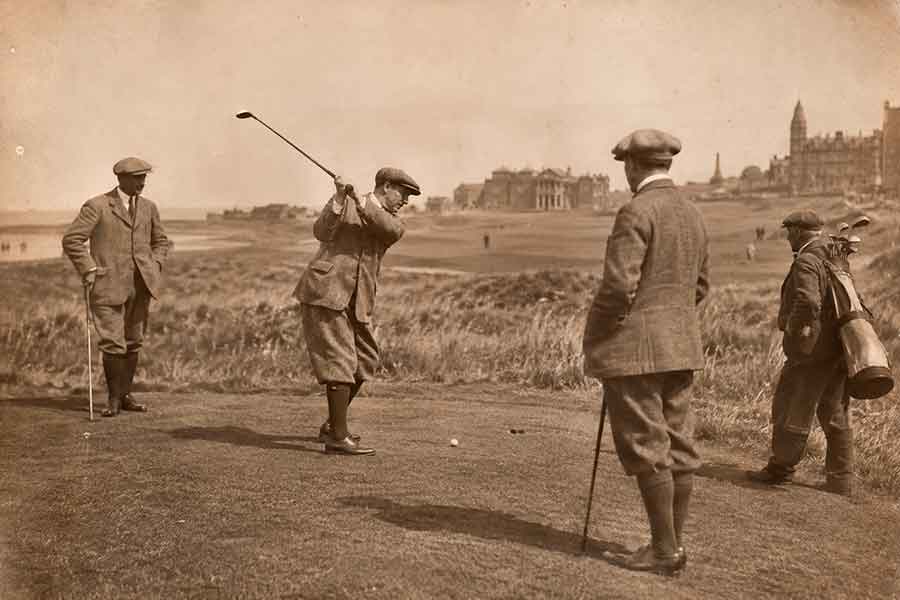
The story of how golf moved from that variety to the format we know today is closely linked to the Old Course at St Andrews. In 1764, a change to the layout reduced the number of holes in a complete round from 22 to 18. The decision addressed a specific issue with the course, but the influence St Andrews would gain as golf developed meant that this configuration eventually became a reference point for the sport as a whole.
Before there were 18 holes
Golf in the 17th and 18th centuries was organised very differently from the game we know today. Courses were not designed according to a fixed length, nor was there a standard model for clubs to follow. Players made use of suitable terrain, and layouts developed according to the characteristics of each location.
One of the earliest documented examples can be found at Leith, near Edinburgh, where a competition was played in 1744 under a set of ten rules. The course had five holes. Other historic courses had different configurations: North Berwick had seven, while Montrose eventually had 13. St Andrews was different again, with eleven holes played first towards the far end of the links and then in the opposite direction on the way back. A complete round therefore consisted of 22 holes.
The layout was closely related to the terrain itself. The links at St Andrews stretched along the coast, providing a strip of land on which the course had developed. Players moved in one direction and then returned through the same area, playing the holes from the opposite end. There was no theory behind the length of the round; the layout reflected the most practical way of using the available land.
In 1764, several of those holes were modified because some were considered too short. The eleven outward holes were reduced to nine by combining some of them, and because the return journey followed the same course, a complete round went from 22 holes to 18.
The growing influence of St Andrews
For much of the 18th and 19th centuries, individual clubs had considerable freedom to establish their own rules. The earliest written rules on record were drawn up at Leith, but other clubs subsequently developed their own codes. The USGA notes that, during the hundred years following 1744, more than 30 clubs established sets of rules, many based on earlier versions but with their own modifications.
The same variety could be found in the courses themselves. Five, seven, thirteen, 18 or more than 20 holes were all possible configurations because golf remained closely connected to each club and its surroundings. This began to change as the sport spread and players travelled more frequently to compete at other courses.
Differences between rules, formats and layouts became increasingly important. St Andrews gained influence during this period, and the Royal and Ancient Golf Club gradually became a major reference point for the rules of the game. The Old Course already had a long tradition behind it, and its 18-hole layout began to be regarded as a model.
A match defined over 18 holes is documented at St Andrews as early as 1842, showing that this configuration had already become part of the club’s established way of playing a round.
How 18 holes became the standard
The transformation of 18 holes into the standard format was gradual. During the 19th century, courses with other configurations still existed, but the expansion of golf made it increasingly useful to have a recognised format for competitions.
Historian Peter N. Lewis, in a study published by The R&A, places an important part of this process during this period. In the 1880s, as the number of players and clubs grew significantly, 18 holes increasingly came to be accepted as the appropriate configuration for a complete round.
The development of the rules followed a similar path. The Royal and Ancient Golf Club of St Andrews established its Rules of Golf Committee in 1897, and a consolidated code of the Rules of Golf was published in 1899. Having an increasingly standardised format for a round made it easier to organise competitions between clubs and gave players more comparable conditions from one course to another.
By the end of the 1890s, when British clubs formally recognised the Royal and Ancient Golf Club as the governing authority for the rules, many courses that still had different layouts had to adapt their courses to 18 holes. A number that had emerged from the particular evolution of the Old Course had become a reference point for the game.
From the Old Course to the United States
The international expansion of golf helped consolidate the format. In the United States, some of the sport’s early architects looked to the great British courses for inspiration, with St Andrews occupying a particularly important place.
Charles Blair Macdonald was one of the leading advocates of this tradition. When he designed the Chicago Golf Club, he created an 18-hole course inspired to a large extent by the Scottish model. The course is considered the first 18-hole course in the United States and brought several of the principles Macdonald had encountered during his travels in Britain to the new continent.
From that point onwards, new courses could feature completely different terrain, climates and architectural solutions while sharing a structure that was already familiar to golfers. Eighteen holes provided a common framework within which each architect could develop their own interpretation of a course.
A common structure for very different courses
Standardising the number of holes did not make golf courses alike. An 18-hole round can accommodate courses with very different strategies, distances and characteristics. A layout can alternate long and short holes, use changes of direction, water hazards or variations in terrain, and ask the golfer to make different decisions as the round progresses.
Golf architecture uses this structure to create a sequence. The position of each hole within the round, its relationship with the holes before and after it, and the conditions of the terrain all contribute to the overall strategy of the course.
The current Rules of Golf continue to recognise 18 holes as the reference for a complete round, while also allowing rounds of fewer holes when established by the Committee. The tradition therefore remains firmly in place without preventing other ways of structuring the game.

From Scotland to the Mediterranean
More than two centuries after that change at St Andrews, 18 holes have become part of courses all over the world. The structure has remained while the landscapes and design solutions have changed completely.
At Alcanada, the course designed by Robert Trent Jones Jr. runs alongside the Bay of Alcúdia, in a Mediterranean landscape very different from the Scottish links where this tradition began. The course uses the classic 18-hole structure within a design adapted to the terrain and conditions of Mallorca.
The history of the 18 holes shows how some of golf’s most established conventions grew out of very specific circumstances. In 1764, reducing the St Andrews course from 22 to 18 holes addressed an issue related to the design of that particular course. Over time, the influence of the club, the development of the rules and the international expansion of golf transformed that solution into a shared tradition.
Since then, materials, technology, equipment and course design have all changed. So have the places where golf is played. The 18-hole structure, however, continues to connect the historic links of Scotland with modern courses beside the Mediterranean.
Alignment affects the club’s path, the direction of the clubface and the ball’s flight.
Become a volunteer!
As you approach a green with significant slopes, the distance to the flag is no longer enough to decide which club to play.
