




Índice
The fairway can look small from the tee, particularly when trees, bunkers, water or out-of-bounds areas affect the line of play. In this situation, choosing the right club requires more than simply deciding whether to use the driver or leave it in the bag.
Distance, your usual dispersion pattern and the hazards on the hole all help determine which option makes the most sense. In some cases, that will be the driver. In others, a fairway wood, hybrid or iron may fit the strategy of the hole better.
What actually makes a tee shot narrow?
The width of the fairway is only part of the picture. It is also important to consider where the hazards begin and how far each club carries.
A bunker at a certain distance may be out of play with an iron but come into play with a fairway wood. The same applies to water or an out-of-bounds area. Before choosing a club, look at the hole from the tee and identify the area where you want the ball to finish.
It is also worth identifying which side gives you more room for error. If a miss to the right can finish in water while a similar miss to the left leaves the ball in play, that difference should be part of the decision. Club selection should reflect the actual layout of the hole and the way you normally hit each club.
When should you use the driver?
A narrow tee shot does not automatically mean you should use a shorter club. For many golfers, the driver can still be the right choice if their dispersion pattern allows them to keep the ball in play.
Data from Shot Scope analysed by Golf Digest shows that the difference between the driver and 3-wood in terms of fairways hit can be small. Among mid-handicap golfers, the figure was 46% with the driver compared with 48% with a 3-wood, while the average distance difference was 19 yards in favour of the driver.
This changes the way the tee shot should be viewed. Using a 3-wood does not automatically guarantee a significant improvement in accuracy, while it can leave considerably more distance for the second shot.
The driver also has a larger clubhead and is designed to provide forgiveness on off-centre strikes. Its performance, however, depends on the model, the fitting and the characteristics of the individual golfer. A properly fitted driver can therefore be a very accurate option for certain players.
The decision should be based on what actually happens with each club. If the driver keeps the ball within a playable area, its additional distance can be valuable. If a hazard clearly comes into play with the driver, there is a specific reason to consider another option.
Is a 3-wood a safer option?
A 3-wood can make sense when it helps avoid a hazard, control the position of the tee shot or suit the shape of the hole. A dogleg that can be played more effectively with less distance, for example, may justify choosing a different club. The same applies when the main risk lies towards the end of the driver’s usual range.
What is worth avoiding is the assumption that less distance automatically means greater accuracy. Shot Scope data shows that the difference in fairways hit between the driver and 3-wood can be small, while the loss of distance can be significant.
The 3-wood should offer a specific advantage. If it does not materially change the risk of the shot, giving up distance may simply leave a longer second shot. If it helps avoid a troublesome area or reach a more favourable position from the tee, the decision becomes more compelling.
When should you choose a hybrid or iron?
There are tee shots where it makes sense to stay below the range of a fairway wood. This can happen when a hazard requires you to stop short of a particular area, or when the position for the next shot matters more than gaining extra yards.
In these situations, a hybrid or iron can be a sensible alternative. The choice will depend on the distances you achieve with each club and how well that club fits the demands of the hole.
Knowing the actual distances in your bag makes this decision easier. If you know how far you hit your long irons, hybrids and fairway woods, you can compare those distances with the hazards and landing areas before making your choice.
There is no universal distance that determines when you should use a hybrid or iron from the tee. The reference point should be your own game and the demands of the shot.
Which hazards should you consider before choosing?
Looking only at maximum distance can lead to a poor decision.
Imagine a par 4 with water on the right and an open area on the left. If the driver can reach the water with a wayward shot while a 3-wood allows you to stay short of it, giving up some distance may be justified.
The situation can also be different if the hazard is within reach of both clubs. In that case, changing from driver to 3-wood may do little to reduce the risk, and other factors need to be considered, such as your usual dispersion, the distance remaining to the green and the position from which you will play your second shot.
A practical way to assess the tee shot is to imagine where the ball would finish with your normal shot and what would happen with your most common miss. This gives you a more realistic way to assess the risk than simply looking at the maximum distance of each club.
How does club dispersion affect your choice?
A club’s distance only tells part of the story. From a narrow tee, it is also important to know how far the ball tends to deviate from your target.
A golfer may generate plenty of distance with the driver while having enough lateral dispersion to bring the hazards into play. Another player may have a tighter pattern and be able to take advantage of the extra distance without taking on the same level of risk.
That is why club selection should be based on your actual shot pattern. If you have access to launch monitor data, looking at lateral dispersion and carry distance for each club can help you determine which options keep the ball within a playable area more consistently.
Confidence with the club also deserves consideration. A club that allows you to make a natural, repeatable swing may be preferable to one that appears more suitable in theory but creates uncertainty during your pre-shot routine.
Where should you aim when the fairway is narrow?
A narrow fairway does not necessarily mean aiming at the centre. If your usual miss is towards one side and there is more room on the other, you can adjust your target to allow for that tendency.
It is also useful to distinguish between aiming at a specific point and choosing a target area. A GOLF Magazine study involving 32 players compared the two approaches from the tee. The players found the fairway 60% of the time when using a broad target area, compared with 50% when focusing on a precise point in the centre. The study included shots with both driver and 3-wood.
The results provide a useful reference when preparing for a tee shot, although they do not mean that every golfer should always use a broad target. On a narrow fairway, visualising the available landing area may be more useful than trying to hit one exact point.

How should you adjust tee height for each club?
Tee height should also be adjusted according to the club you choose.
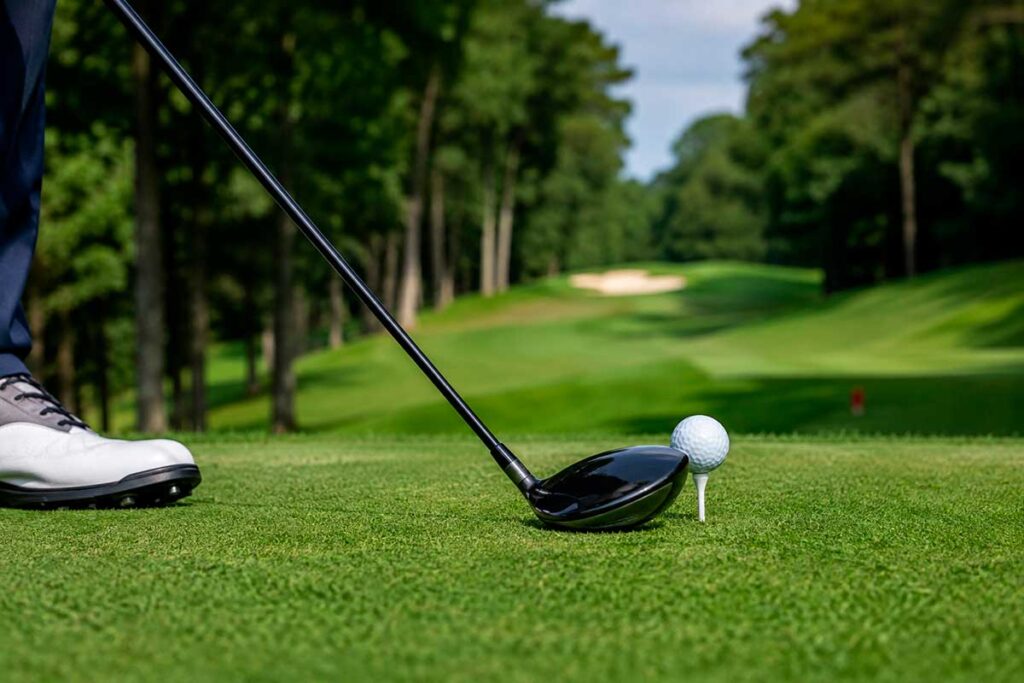
With the driver, a common reference is to position the ball so that roughly half of it sits above the crown when the club is resting behind the ball. The appropriate height also depends on your angle of attack and the type of shot you are trying to play.
With a fairway wood or hybrid, the ball should sit much closer to the ground. A practical reference is to have the bottom of the ball slightly above the top of the clubface when the club is resting on the ground.
With an iron, the tee should be almost level with the turf, creating impact conditions similar to those of a shot from the fairway.
These are simple adjustments, but keeping them consistent helps avoid unnecessary variables in a tee shot that already requires precision.
Which club should you choose for the hole?
If the fairway is narrow but the hazards are beyond the driver’s reach, taking advantage of its distance can be a good decision. If a hazard clearly comes into play and a shorter club allows you to stop short of it, stepping down in club can make sense.
When a 3-wood does not materially change the risk compared with the driver, the loss of distance needs to be part of the calculation. If it allows you to avoid a troublesome area or adapt to the shape of the hole, it may be the more appropriate alternative.
A hybrid or iron can come into play when you want to leave the ball short of a hazard or reach a specific distance for the second shot. In every case, the decision depends on your actual distances and the layout of the tee shot.
A simple decision before you hit
Before addressing the ball, take a moment to look at the landing area, identify the hazards and consider your most common miss with the club you are considering. The distance you want to leave for the second shot can then help complete the decision.
The best club for a narrow tee shot does not necessarily have to be the shortest or the one that goes furthest. It is the club that offers the right balance of distance, dispersion and risk for that particular tee shot.
At Golf Alcanada, strategy is part of the playing experience. The course presents situations where reading the landing area, assessing the risks and choosing the right club can influence how the hole develops. To work on these decisions before taking them onto the course, the practice area with Toptracer technology allows you to analyse shot distances and trajectories, while the Golf Alcanada Academy provides professional guidance to help improve different aspects of your game. Preparation and practice therefore have their place before you step onto the next tee.
Golf Alcanada combines a course designed by Robert Trent Jones Jr., facilities to help you improve your game and a privileged location beside the Bay of Alcúdia.
What makes Alcanada such a distinctive venue for a tournament of this level?
A good pre-shot routine does not have to be long or complicated.
