


Índice
When we talk about precision in golf, most players automatically think about technology, GPS watches, or laser rangefinders. However, there is one resource that has always been part of the game and remains essential today: using the environment as a distance reference in golf.
From our experience at Golf Alcanada, we see how players who learn to read the course beyond exact yardages develop better strategic management and greater adaptability.
Understanding how to use the natural surroundings as a reference while playing golf can make a real difference in performance. In this post, we explain how to do it.
Why the environment influences distance perception
The ability to interpret natural and visual elements of the course helps players make more accurate decisions, especially in situations where exact data is unavailable or conditions constantly change.
A player’s visual perception changes depending on factors such as:
- Elevation changes.
- Presence of water.
- Vegetation.
- Slopes.
- Light direction.
- Wind.
All of these elements modify the real perception of depth and influence shot selection.
Natural elements as a distance reference in golf
Trees and vegetation
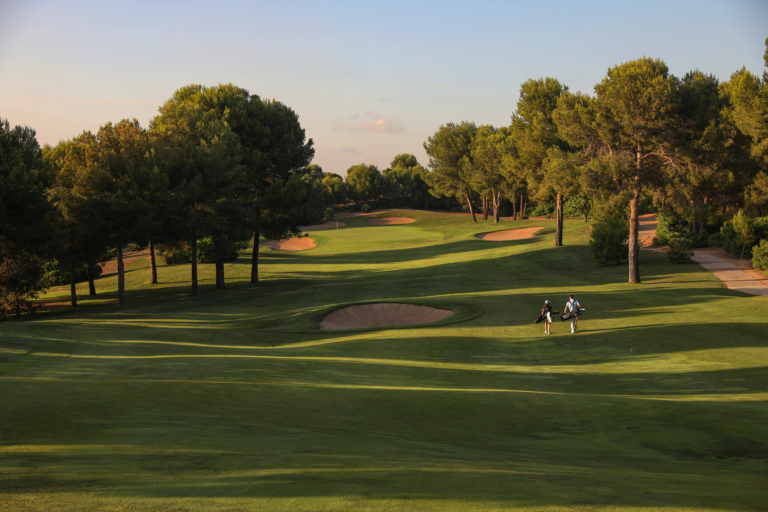
The height and position of nearby trees help interpret depth and perspective.
In many situations:
- A tree located behind the green helps visualize the real distance more accurately.
- Dense vegetation helps identify elevation changes.
- Shadows provide additional visual references.
Vegetation works as a fixed point within the course.
Slopes and elevation
Topography completely influences visual perception.
On uphill shots:
- The target usually appears closer.
- The ball generally requires more actual distance.
On downhill shots:
- The target often appears farther away.
- The shot may require less power.
Correctly interpreting elevation changes helps avoid common distance mistakes.
The sea and open spaces
On coastal courses like those at Golf Alcanada, open surroundings significantly alter visual perception.
The lack of nearby visual references can:
- Make targets appear farther away.
- Make depth perception more difficult.
- Alter the sensation of height and distance.
In addition, sea breeze introduces another variable that directly affects ball flight.
Common mistakes
Relying only on first visual impressions
Initial visual impressions are often misleading. Factors such as sunlight, the sea, or elevated greens can distort real distance perception and lead to poor club selection.
Ignoring elevation changes
Many players only calculate horizontal distance and forget how slopes influence the shot. Uphill shots usually require more effective distance, while downhill shots require less force.
Not considering the wind
Wind changes both ball flight and shot perception. On open or coastal courses, reading it correctly is essential to maintaining distance control.
Depending only on technology
GPS devices and rangefinders are useful, but they do not interpret variables such as terrain, wind, or ground firmness.
Frequently asked questions
Why is it important to learn visual references if GPS and rangefinders exist?
Technology provides precise data, but it does not interpret the full context of the shot. Factors such as wind, slope, or visual depth still depend on the player’s ability to read the course.
In addition, devices are not always available, and conditions can sometimes limit their effectiveness. Learning to use visual references improves adaptability and leads to more complete decision-making. Visual interpretation remains an essential part of golf.
Which natural elements are most useful for calculating distance?
The most useful elements are usually trees, elevation changes, bunkers, vegetation lines, or references located behind the green. All of them help interpret depth and height while improving the understanding of different areas of the course.
The more stable and visible the reference, the more useful it becomes for distance judgment. The key is learning to connect those references with real distances.
Can the environment distort distance perception?
Yes. Visual perception constantly changes depending on course design and environmental conditions. Elevated greens, open backgrounds, or steep slopes can alter the real sensation of depth.
On seaside courses, the absence of nearby references may make targets appear farther away than they actually are. These visual distortions are common even among experienced players. That is why training environmental reading is important.
How does wind affect distance reference in golf?
Wind not only changes ball flight, but also alters visual perception of the shot. On open courses, players may misinterpret real distance because of atmospheric conditions. A headwind usually requires more effective distance, while a tailwind reduces the amount of power needed.
Crosswinds also affect approach strategy into the green. Correctly reading the wind is a fundamental part of course management.
Can distance perception be trained?
Yes. One of the most effective methods is estimating distances before using measuring devices and then comparing the results afterward. This process helps identify visual patterns and correct perception mistakes.
With consistent practice, players develop a more intuitive and accurate understanding of the course. Courses with elevation changes and varied visuals especially help accelerate this learning process.
Why does visual perception change so much on coastal courses?
Courses near the sea usually have fewer enclosed visual references, which alters depth perception. Open spaces often make targets appear farther away than they really are.
In addition, light, wind, and the open horizon constantly modify the player’s perception. This forces golfers to develop a more accurate reading of the environment.
On technical seaside courses, correctly interpreting these variables creates a significant competitive advantage.
Learning to use the environment as a distance reference in golf allows players to develop a much more complete understanding of the course. Precision does not depend only on measuring yardages, but also on correctly interpreting terrain, depth, and visual conditions.
With practice and experience, this ability improves decision-making and adds greater consistency to the game.
At Golf Alcanada, we work precisely with this type of real golf, where the environment actively influences every shot. If you want to improve your strategic course reading and develop a more complete adaptation to the game, training on a technical course like ours makes a real difference.
Become a volunteer!
As you approach a green with significant slopes, the distance to the flag is no longer enough to decide which club to play.
Preparing your body before a long round can take just a few minutes. Discover a simple routine to get your legs, mobility and swing ready before heading onto the course.
