





Índice
You may not have a visible reference, the ball may be on a slope, or you may simply not have a reliable measurement. You still have to decide which club to play. In these situations, knowing how far you normally hit each club gives you a useful starting point. The lie, the terrain, the wind and the area where you want the ball to finish can also help narrow down the choice.
How to choose a club when you don’t know the exact distance
Start by thinking about the shot in front of you and the usual carry distance of each club. Your own numbers are more useful than general figures because they take into account your swing speed, contact and the trajectory you normally produce.
If you usually hit a 7-iron around 140 metres and the target appears to be somewhere in that range, you already have enough information to narrow down your options. You do not need to know whether the target is exactly 137 or 142 metres away. It is also worth looking at what surrounds the target. If there is water, a bunker or a difficult area behind the green, the decision may change even if two clubs appear suitable on paper.
What hazards are between the ball and the target?
Before choosing a club, look at the route the ball has to travel. A hazard in front, a penalty area or a particularly narrow fairway can make an apparently obvious choice less suitable.
Suppose a 6-iron and a 7-iron could both reach the intended area. If the 6-iron leaves little room before a hazard while the 7-iron allows you to come up slightly short without getting into trouble, the second option may be safer.
The position you want for the next shot matters too. On some holes, giving up a few metres can leave the ball in a much better position for the shot that follows.
How far does each club go in your game?
Knowing the usual distance of your clubs makes these decisions much easier. You do not need to memorise an exact figure for every club. It is enough to know what each one normally produces when the shot is executed as expected.
There is an important difference between the distance you achieve regularly and the distance you can reach with a perfect strike. When making decisions on the course, the first is the more useful reference.
You can refine this information over time during rounds and practice sessions. The better you understand how each club performs, the less dependent you are on having an exact measurement before making a choice.
What should you do when you are between two clubs?
This is often the most difficult situation when you do not have a clear reference.
Imagine you are choosing between a 6-iron and a 7-iron. Instead of asking only which one can reach the target, think about what could happen if the contact is slightly different from what you intended.
With a 6-iron, for example, you may reach a distant target more easily, but you may also finish long if you strike the ball well. With a 7-iron, you may have to accept that the ball will finish short, while still leaving a playable shot.
The useful question is which miss you would rather accept. If coming up short leaves a straightforward approach while going long brings a penalty area into play, the 7-iron may be the better choice.
How do wind and slope affect club selection?
Wind can completely change a decision that initially seems straightforward. A ball that carries 140 metres in normal conditions may not travel the same distance into a headwind or with the wind behind you.
Slope also changes the situation. A ball on an uphill or downhill lie requires you to consider how the change in elevation will affect the shot. The lie can have a similar effect, particularly when the position of the ball makes clean contact more difficult.
Before deciding, take a moment to look at the ball, the terrain and the direction of the wind. That assessment may be enough to favour one club over another.
When should you choose a club with more margin?
When there is trouble around the target, playing with some margin can be a more sensible decision than trying to hit the perfect shot.
This is particularly relevant when two clubs offer similar possibilities. If one requires you to reach the upper end of your usual range while the other gives you more room to work with, the second may make more sense.
The same principle applies when planning the next shot. A ball that finishes a few metres farther from the target can leave you with a better opportunity than one that ends up in a bunker or penalty area.
What should you do if the distance is still unclear?
If you still do not have a precise reference after assessing the situation, narrow the choice down to the clubs that can realistically work.
Rule out the ones that would require an exceptional shot and those that would leave the ball too far from the target. Then compare the consequences of coming up short and going long. If one of those misses is clearly worse, the decision often becomes easier.
Over time, these situations become easier to read. Playing more rounds and spending time on the practice ground helps you understand what each club normally produces and how your shots react to different conditions.
An exact measurement is not always available on the course. Knowing your own yardages, reading the situation and allowing for a reasonable margin of error can be enough to make a sound decision.
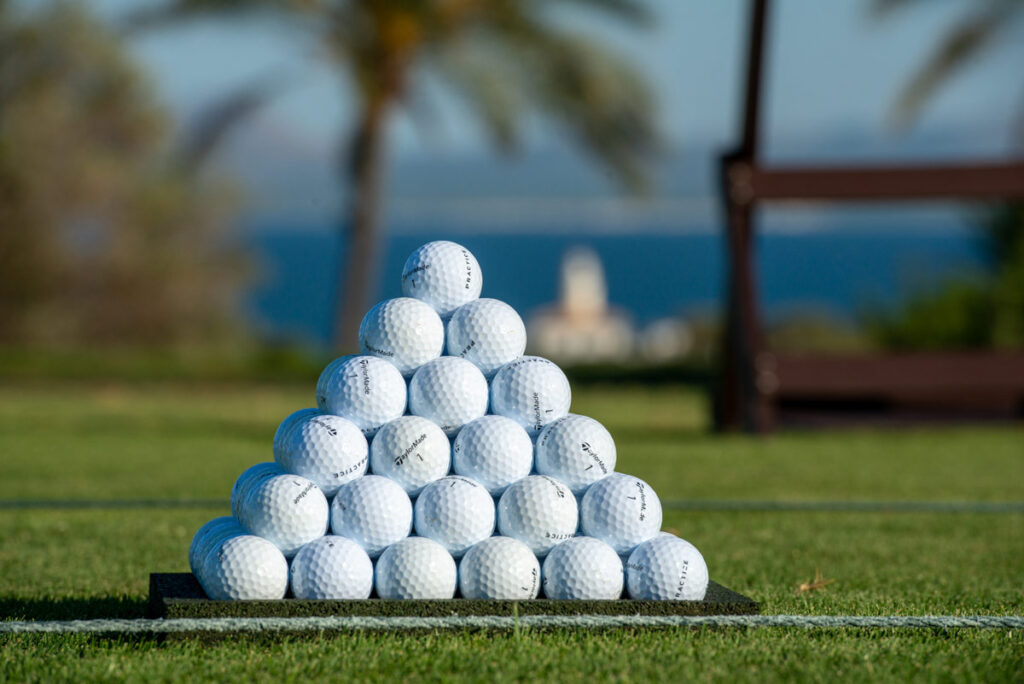
At Golf Alcanada, the practice area gives you the opportunity to get to know the distances of your clubs and see how the result changes with different types of shots. The Golf Academy at Alcanada, led by PGA professionals, can help you work on this part of your game in a more focused way and then take those references onto the course.
Golf Alcanada combines a course designed by Robert Trent Jones Jr., facilities to help you improve your game and a privileged location beside the Bay of Alcúdia.
What makes Alcanada such a distinctive venue for a tournament of this level?
A good pre-shot routine does not have to be long or complicated.
