


Índice
Visual awareness is also part of golf strategy. Two players can stand in exactly the same position and choose different shots because they read the course in different ways.
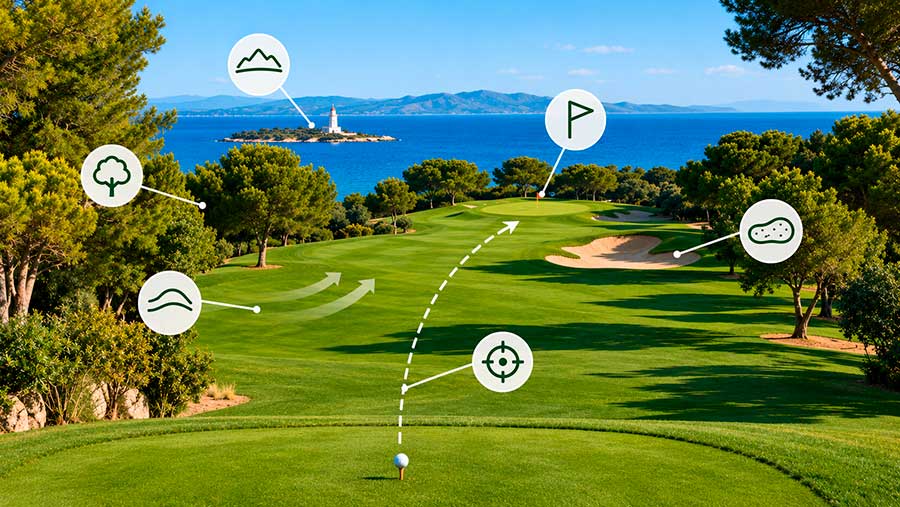
Before taking a shot, it is worth spending a few seconds studying the hole. The position of the trees, bunkers protecting the fairway, changes in elevation and the shape of the green all provide clues that can help you choose the right club and plan your shot. Learning to recognise these details makes it easier to anticipate challenges and make better decisions throughout your round.
What features of a golf course can you use as visual references?
Every golf course combines features shaped by its design with elements of the surrounding natural landscape. Knowing how to recognise them gives you more ways to navigate the course during a round.
Bunkers define areas of risk and influence your strategy from the tee. Their position helps you identify which part of the fairway offers the most room for error and how far you should aim to hit the ball. A bunker along one side of the fairway can help you establish your target line, while one positioned near the landing area may force you to consider whether to carry it or choose an alternative route.
Trees and lines of vegetation provide recognisable points for orientation. A solitary tree at the end of a fairway can help you establish your intended direction. Groups of trees and vegetation also make it easier to identify the boundaries of a hole and understand how the layout develops from the tee.
Slopes and changes in elevation affect both distance and ball trajectory. A downhill fairway can give the ball more roll after landing, while an uphill section will generally reduce its overall distance. Side slopes also deserve attention, particularly when the ball comes to rest on an uneven lie that could influence your next shot.
The green and the flag provide much of the information needed to plan an approach. The flag marks the position of the hole, but the shape and contours of the green help you decide where to land the ball. If bunkers or other hazards protect the entrance, aiming for a wider landing area may be a better option than going directly for the flag.
The surrounding landscape can also provide useful reference points. A mountain, the coastline or a recognisable natural feature can help you maintain your bearings, particularly on open courses where the horizon becomes part of your perspective.
How to use visual references before each shot
From the tee, start by identifying the hazards that could come into play and the area of the fairway where you want your ball to land. If a bunker occupies part of the landing area, look for a reference point beyond it or to one side. This gives you a clear target line, rather than aiming at a general area of the fairway.
To improve your alignment, choose an intermediate target close to the ball. It could be a small mark on the grass or an irregularity in the ground along your intended line. Using this point to position the clubface and align your body makes it easier to prepare for the shot.
When playing approach shots to the green, shift your attention to the putting surface. Locate the flag, study the shape and contours of the green and check whether bunkers or slopes could affect your entry. The position of the hole matters, but so does the area where your ball is likely to finish if the shot does not go exactly as planned. Thinking about your next shot can help you choose a more suitable target.
Wind adds another variable. The surrounding landscape can offer clues about its direction, although it is worth checking the movement of the vegetation and how the air feels where you are standing. Your final decision will also depend on the lie of the ball and the club you choose.

How course design influences the way you read the game
The arrangement of hazards and the layout of each hole determine the options available to the golfer. A cross bunker, a narrowing fairway or a green protected by changes in elevation can completely alter your strategy from the tee or on your approach. Learning to read a course also means understanding the decisions its architecture presents.
At Golf Alcanada, the design by Robert Trent Jones Jr. is integrated into a landscape shaped by its proximity to the Mediterranean. The relationship between the layout, the hazards and the natural surroundings offers different perspectives as you make your way around the course. Paying attention to how each hole is designed helps you recognise the available options and plan your shots with greater confidence.
Discover Golf Alcanada from a different perspective
Located alongside the Bay of Alcúdia, Golf Alcanada offers a golfing experience in which the landscape is part of the round. The Mediterranean horizon accompanies players throughout the course and gives it a distinctive sense of place. Each hole has its own visual references and calls for a different reading of the terrain.
If you want to work on your technique and improve your ability to read a golf course, discover the Golf Alcanada Academy, where you can benefit from tuition with professional instructors. To plan your next round, explore our green fees and special offers. If you need any further information, feel free to contact our team.
Discover Golf Alcanada and enjoy the course from a new perspective.
Discover how themed golf tournaments are bringing fresh ideas to golf competitions, attracting new players and offering new ways to enjoy the game at Club de Golf Alcanada, Mallorca.
Discover how playing golf by the Mediterranean changes your experience. Explore the coastal scenery, natural challenges and unique atmosphere of Golf Alcanada, overlooking the Bay of Alcúdia in Mallorca.
Learn how to adapt your swing when the ball sits above or below your feet. Practical tips to adjust your stance, control ball flight and improve accuracy from uneven lies.
